Housing in large-scale developments & multi-residential buildings: accessible & secure

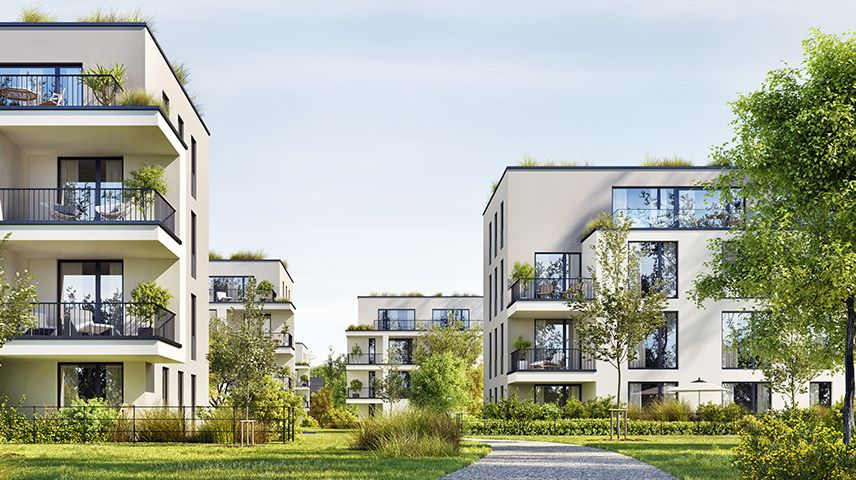
Throughout Switzerland, large-scale construction projects are increasingly opting for barrier-free, flexible, and secure housing concepts to meet the diverse needs of residents. In these projects, innovative access solutions are just as crucial as compliance with applicable building codes and standards.
Throughout Switzerland, large-scale construction projects are increasingly opting for barrier-free, flexible, and secure housing concepts to meet the diverse needs of residents. In these projects, innovative access solutions are just as crucial as compliance with applicable building codes and standards.
Barrier-free living space becoming increasingly important
In addition to providing affordable living space, construction projects that adapt the living space to different living situations are gaining in importance. More than 2 million people in Switzerland already need barrier-free access today, including around 600,000 people with severe disabilities and 1.6 million people over the age of 65. As they will account for around a quarter of the total population by 2050, a high-rise building suitable for older residents is going to be built in Seebach, Zurich. The building will be accessible and feature a health center.
Demographic change requires large-scale construction
By 2050, the Swiss Federal Statistical Office expects the residential population to increase to 10.4 million people. As the search for affordable housing in urban centers is already a major challenge for families, cities such as Lucerne and Zurich are tackling this problem with comprehensive development concepts such as large-scale developments and multi-residential buildings.
For example, the housing cooperative SBL Wohnbaugenossenschaft in Lucerne is planning the construction of 103 apartments including a preschool, “cluster apartments” (small apartments sharing common spaces), guest suites, commercial spaces, and a bicycle workshop. With the “Harsplen” project, the City of Zurich aims to increase the proportion of non-profit rental housing in its housing stock to one third and create housing for at least 700 people by 205
Inclusion & diversity: residential projects following the “design for all” principle
The planning of large-scale developments and multi-residential buildings is not only about creating living space, but also about the diverse interests and living situations that must be considered for barrier-free living. This applies in particular to the minimum requirements of the Disability Equality Act (BehiG), as these are already mandatory in most cantons for buildings with four or five housing units or more.
In line with the “design for all” philosophy, the standards SIA 500 “Obstacle-free buildings” (Chapters 9 and 10) and VSS SN 640 075 “Obstacle-free traffic space” regulate which concepts must be implemented. The requirements for specific forms of housing go one step further, beyond the general requirements for residential buildings. For these special buildings, which include retirement homes as well as residential and care facilities, the “Richtraumprogramm” guidelines defined by some cantons must be studied in addition to SIA 500.
“In order to ensure that the correct measures are implemented in each individual case, dialog with the relevant authorities should be sought at an early planning stage,” emphasizes Sandro Ramundo, Team Leader Specification & Key Account Management PEU at ASSA ABLOY (Schweiz) AG.
Accessible living for all: focus on minimum dimensions & drop-down seals
At the same time, these requirements have direct consequences when it comes to equipping residential complexes with suitable access technologies. Obstruction-free passageways require minimum dimensions for traffic areas, passageways, corridors, and doors. Since even the smallest edge can be a tripping hazard for wheelchair users and elderly people, door systems should use suitable drop-down seals to enable barrier-free living.
After the entry into force of the accessibility standard DIN EN 17210, which reduces the maximum permissible threshold height to 10 mm, low-profile solutions are in demand here. Planet drop-down seals from ASSA ABLOY meet precisely these criteria.
Door handles & door closers: standard-compliant solutions for barrier-free access
However, removing steps or thresholds alone is not enough to make doors completely accessible. The physical force required to open a door also plays a role. The specifications of SIA 500 must therefore be taken into account; for example, door handles must be easy to grip. A special door handle design that facilitates operation at the end of the handle can also support the lever action. The force torque that must be taken into account when using door closers is also standardized. According to SIA 500, these must be operable:
-
with a maximum force of 30 N and
-
at an opening speed of approx. 1°/s.
Special door closers from ASSA ABLOY can keep this counter pressure low, for example:
-
using CAM-Motion technology to reduce opening resistance
-
and by using a hydraulic closing delay, which allows more time to pass through the door.
At the same time, there are solutions in which the door closer function is only activated when required and the hydraulic closing function is enabled by pressing a button or actuated by the fire alarm system, for example. This has the advantage that doors can run smoothly or even remain open during daily operations and are barrier-free.
Secure, barrier-free locking solutions for large-scale developments: mechanical & electronic
Since large-scale developments have a higher number of residential units, effective and barrier-free locking technology is also essential. Modern mechanical burglary protection should correspond to at least class RC2 within the DIN standard series EN 1627–1630 or VdS class N. Modular mechanical locking systems, which offer cylinder profiles for apartment doors, furniture and cabinet doors, mailboxes, garages, or elevator control systems, are recommended, especially for large-scale developments and multi-residential buildings.
In mixed-use properties, such as residential and commercial spaces or healthcare facilities, the use of an electronic locking system can pay off. KESO eCLIQ from ASSA ABLOY offers great flexibility and a high level of administrative convenience, for example through:
-
easy management and updating of access rights,
-
time-limited authorizations,
-
possibility to immediately deactivate lost keys via CLIQ Web Manager software,
-
complete documentation of all locking events
In this way, modern, barrier-free locking systems not only contribute to security and efficiency, but also to inclusion and user-friendliness for all groups of residents.
- Multi-residential