Fire doors: in an emergency, the entire system counts

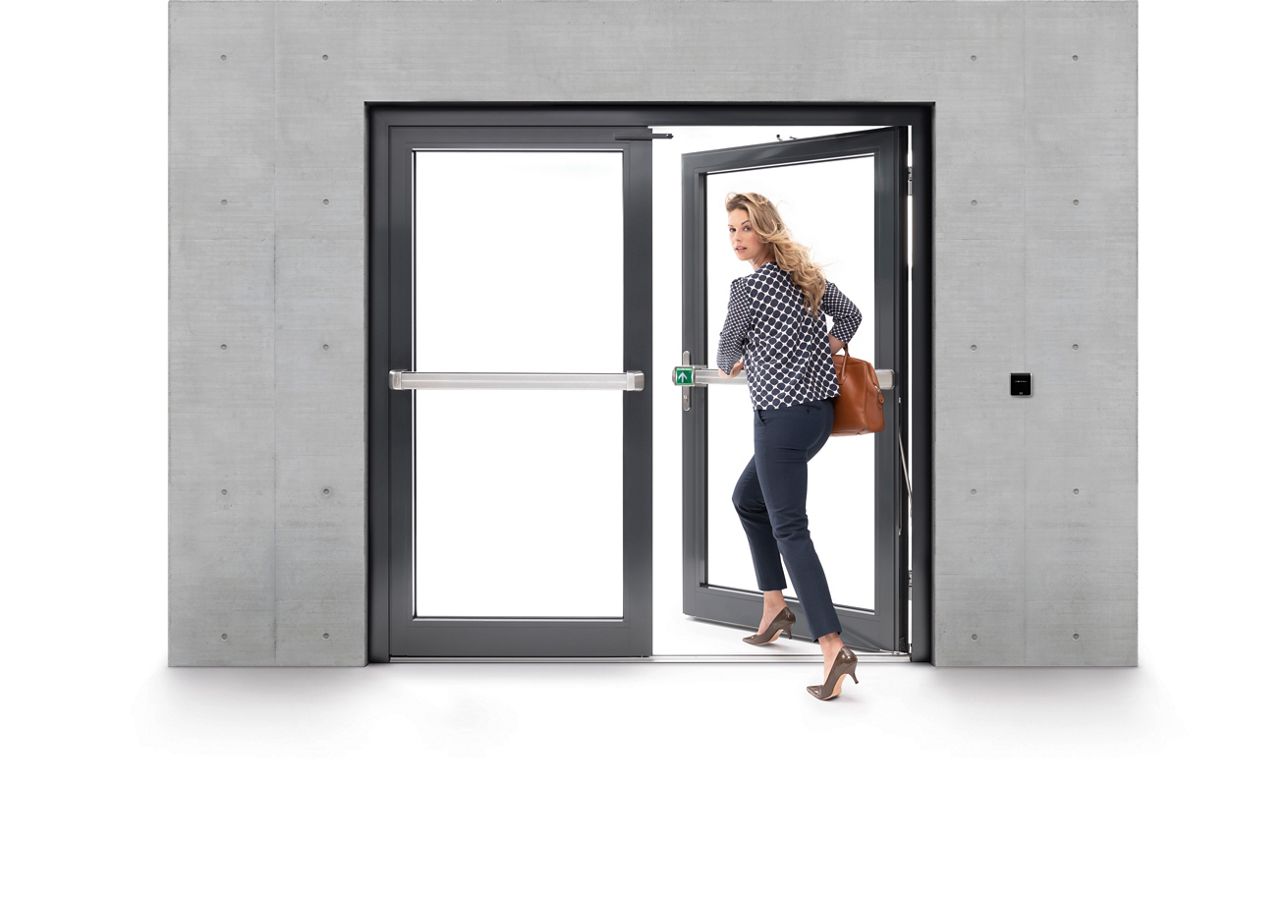
Around 8,600 cases of fire damage to buildings, resulting in damages totaling around CHF 340 million: these were the figures estimated by the Swiss Advisory Board for Fire Prevention (BFB) for Switzerland in 2025. For people, the greatest danger is usually not the flames, but the smoke. Fire doors are designed to limit the spread of smoke and keep exit routes usable for as long as possible. However, they can only fulfill this task as part of a carefully planned, tested, and maintained overall system.
Closed when it matters
Fire compartments divide a building into areas designed to prevent the spread of fire and smoke for a defined period of time. Where a passageway interrupts this separation, the fire door serves as the barrier. The EI30 classification, for example, means that, when tested, the fire door provides integrity (E) and thermal insulation for at least 30 minutes.
In the event of a fire, however, the door must be closed. But this does not mean that every fire door in Switzerland requires a door closer.
When is a door closer required in Switzerland?
The applicable VKF (Association of Swiss Cantonal Fire Insurance) fire protection guideline 15-15 differentiates according to installation situation and protection concept. Fire and smoke protection barriers that are kept open for operational reasons require an automatic closing device. Doors to vertical escape routes must always be self-closing; doors to apartments, classrooms, individual offices, and technical rooms are exceptions.
Unlike in Germany, for example, where fire barriers must always be designed as self-closing doors, a fire door without a door closer is not automatically considered insufficient in Switzerland. If it is kept closed as intended and if the fire protection concept does not require self-closing, it can comply with Swiss specifications. If, on the other hand, a self-closing design is required – recognizable by the additional classification C, for example – a suitable closing device must reliably bring the door to its end limit.
A tested component does not necessarily make a tested door system
Where a door closer is required, it must not be selected independently of the door. SN EN 1154 assesses, among other things, the closing force, durability, safety, and suitability of a door closer for fire and smoke protection doors. However, it does not prove that any closer can be combined with any fire door.
Fire resistance depends on the interaction of door leaf, frame, hinges, seals, lock or latch, door closer, fastening, and wall connection. Movable fire barriers are tested in accordance with SN EN 1634-1. The combination and installation must therefore be covered by the corresponding certifications. A door closer tested in accordance with SN EN 1154 does not confer fire protection properties on a design that has not been certified.
This also applies to existing doors: a different type of closer, a different slide track, or additional holes may interfere with the tested design. Before retrofitting, it is therefore necessary to determine what the system certification permits.
SIA 343/1 considers the entire life cycle
The Swiss standard SIA 343/1 “Doors” entered into force on February 1, 2025. It replaces the door section of SIA 343:2014 “Doors and gates” and takes into account, among other things, SN EN 16034 for fire and smoke protection properties. The standard accompanies a door from project planning through design and installation to final documentation and maintenance.
For fire doors, this reinforces the system idea: performance characteristics, installation situation, and interfaces must be defined at an early stage. However, SIA 343/1 does not replace the fire protection concept or VKF regulations. These determine the protection function; the standard supports its technical implementation and documentation.
Plan safety and ease of use together
A door closer must be strong enough for the door to close completely despite air pressure, seals, and latch striker plate. However, using the highest setting possible is not automatically the safest solution: excessive opening forces make use more difficult, while insufficient closing force or an unsuitable speed can prevent the latch striker plate from snapping in.
The door width and weight, installation position, opening and closing forces, and frequency of use must be considered together when making a selection. Adjustable closing speed, latching action, and opening damper allow adjustment to the respective situation. Cam-Motion® door closers such as the ASSA ABLOY DC700 reduce the force required to open the door due to their rapidly decreasing opening torque and combine reliable closing with ease of use.
In the case of double-leaf fire doors, the correct closing sequence is another factor. First the stationary leaf must close, then the active leaf. A closing sequence control mechanism coordinates the process. If a door needs to remain open in everyday use, a wedge is not the solution. Electromechanical hold-open devices keep doors open in a controlled manner and release them to close if smoke develops or due to the fire control system. The BIM door solution from ASSA ABLOY, for example, shows how these components work together.
Maintain and document function
Responsibility does not end with acceptance. According to the VKF fire protection guideline on organizational fire protection, fire protection equipment must be regularly inspected and maintained, and the work must be documented. For fire doors, this applies in particular to the unobstructed closing movement, the adjustment of the door closer, the secure snapping in of the latch, hinges, seals and, if applicable, the hold-open device and closing sequence control mechanism.
Damage, retrofits, or operating habits can impair the protective effect. Therefore, it must be considered, during both everyday use and planning, that a fire door is more than just a resistant door leaf. Only when all components work together and the door closes completely at the crucial moment can the fire compartment fulfill its task.
- effeff: Stories on Electric Strikes and