Decentralised management of master key systems for municipalities and waste management

Decentralised management of master key systems for municipalities and waste management
Cyberattacks, vandalism, theft: Such criminal activities are also increasingly affecting public institutions and municipal infrastructures, as well as commercial companies. Apart from the economic damage, this can also have a significant impact on citizens if services provided by public authorities, healthcare facilities or municipal utilities and waste disposal companies are only available to a limited extent or, in the worst case, are no longer available at all. In this context, the security of public institutions and municipal infrastructures is becoming increasingly important.
At the same time, however, municipalities are also faced with the challenge of optimising administrative processes and using their resources efficiently, which is not so easy in practice. Even smaller communities typically consist of several properties. Depending on their function, these facilities and buildings are spread across the entire municipality and due to their different construction dates, uniform locking systems are rare. As these are purely mechanical locking solutions, managing the locking system to effectively separate sensitive areas and processes from customer or visitor traffic requires considerable additional effort. If you don’t want to hand over important keys, then for evening and weekend events, as well as for maintenance or technical work, the presence of an authorised person is required each time to unlock and lock the premises. However, if additional keys are put into circulation, the administrative effort shifts to their permanent tracking. If a key is lost, the affected parts of the master key system must be replaced. This is a complex and cost-intensive process. Electronic locking systems represent an efficient alternative with innovative solutions that both increase security and simplify administration. In particular, the flexible and decentralised management of such systems opens up new perspectives for municipalities in terms of modern facility management.
From town hall to building yard: Eurasburg’s comprehensive security concept
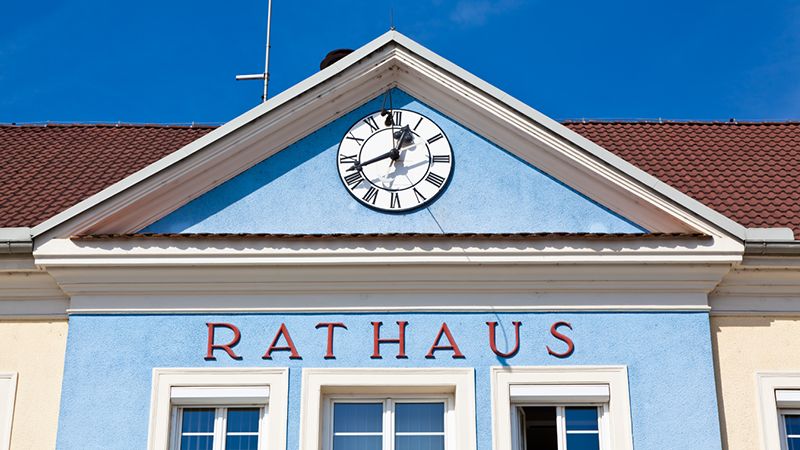
An impressive example of how electronic locking systems can also be used effectively in smaller municipal structures is the municipality of Eurasburg in Bavaria. The municipality, which covers an area of 41 square kilometres and consists of 52 districts, faced the challenge of efficiently and securely managing the town hall, schools, fire stations, community centre and building yard. Over 300 eCLIQ electronic locking cylinders were installed in the buildings. This allows lost keys to be blocked immediately, thus minimising security risks and eliminating the need for expensive replacements. Authorisations can also be limited in terms of time and space. This makes it possible to grant technicians individual authorisation for a specific task, or to grant cleaning staff access to the premises only at certain times. With the flexible online CLIQ® Web Manager platform, the entire master key system can be managed at any time and from any location.
Find out more at https://www.assaabloy.com/de/en/stories/customer-cases/gemeinde-eurasburg
Customised locking systems as the basis for efficient waste management
The problems described here and their solution through the use of electronic locking systems can be applied 1:1 to municipal waste management. Wherever facilities are spread over a large area and need to be integrated into an overarching security concept with complex user groups and rights, systems such as eCLIQ offer clear added value. This applies to landfills, recycling centres and waste incineration plants, for example. It is not only building entrances, but also gates, containers, tanks or special storage rooms for hazardous waste that can be integrated into the system. This not only increases security but also greatly simplifies the alignment of recycling center infrastructures with the increasingly complex requirements for recycling collection and selective storage of waste fractions. An access concept that can be individually defined for waste collection drivers and other internal or external service providers enables precise control over who has access to sensitive areas such as storage facilities for hazardous waste or valuable recyclables, and when.
CLIQ® technology offers great potential for complex administrative structures
The potential of electronic locking systems such as eCLIQ is particularly evident in large and complex structures where decentralised management solutions are required. This applies, for instance, to recycling centres, the number of which has steadily increased in recent years due to the growing importance of the circular economy and the transition to alternative energy sources. According to kommunlawirtschaft.eu, there are currently 3,344 such centres nationwide. Bavaria has the most with 1,501, followed by Baden-Württemberg with 623 and Lower Saxony with 285. Depending on the respective municipal waste management concept, some areas already benefit from a very high level of waste disposal services. In order to provide the most comprehensive network of collection points possible, a district such as Heilbronn operates 51 recycling centers, while Rosenheim has 45.
Significant gains in security and convenience through cloud-based management
With eCLIQ, all these "external sites" can be combined into one single master key system. This applies to a wide variety of door locks in buildings and gates, as well as padlocks on containers. Thanks to the wide range of cylinder designs available in the CLIQ® system, it is possible to combine furniture, lockers, letterbox sets, and switchable systems, such as elevators and industrial cranes, into a single master key system. When CLIQ® Web Manager is used in conjunction with CLIQ® Connect keys in cross-location management, team members can even transfer their access authorisation without an additional programming device on site. The keys are then updated via Bluetooth using the CLIQ® Connect app on the smartphone. This means that the key administrator does not need to be on site but can grant or revoke authorisations for the relevant cylinder across the entire administrative area via a cloud connection. This process not only provides more security but also significantly reduces administrative effort. Real-time electronic management of access authorisations eliminates the need for inconvenient key handover arrangements and replaces time-consuming Excel spreadsheets or paper documentation. This saves time and minimises sources of error, which is a decisive advantage in an industry that often faces tight deadlines and budget constraints.
In order to provide a high level of security and availability of the CLIQ® Web Manager, ASSA ABLOY hosts this cloud service on its own servers and makes it available to individual customers. Customers who wish to monitor access to business-critical information entirely themselves can choose the "in-house operation" usage model. This private cloud variant allows users to determine the location for data storage themselves, a feature that is not always obvious. This gives them complete data sovereignty.
ZMS Schwandorf modernises security with eCLIQ locking system
These advantages have also convinced the Schwandorf Waste Management Association (ZMS). Responsible for waste recycling for almost two million people in Eastern Bavaria, ZMS has equipped its extensive site network with the eCLIQ system. With over 1,000 lock cylinders installed, ranging from offices to control centres to gate controls, ZMS has been able to significantly modernise its security infrastructure while also making the management of access authorisations for 250 employees and external service providers more efficient.