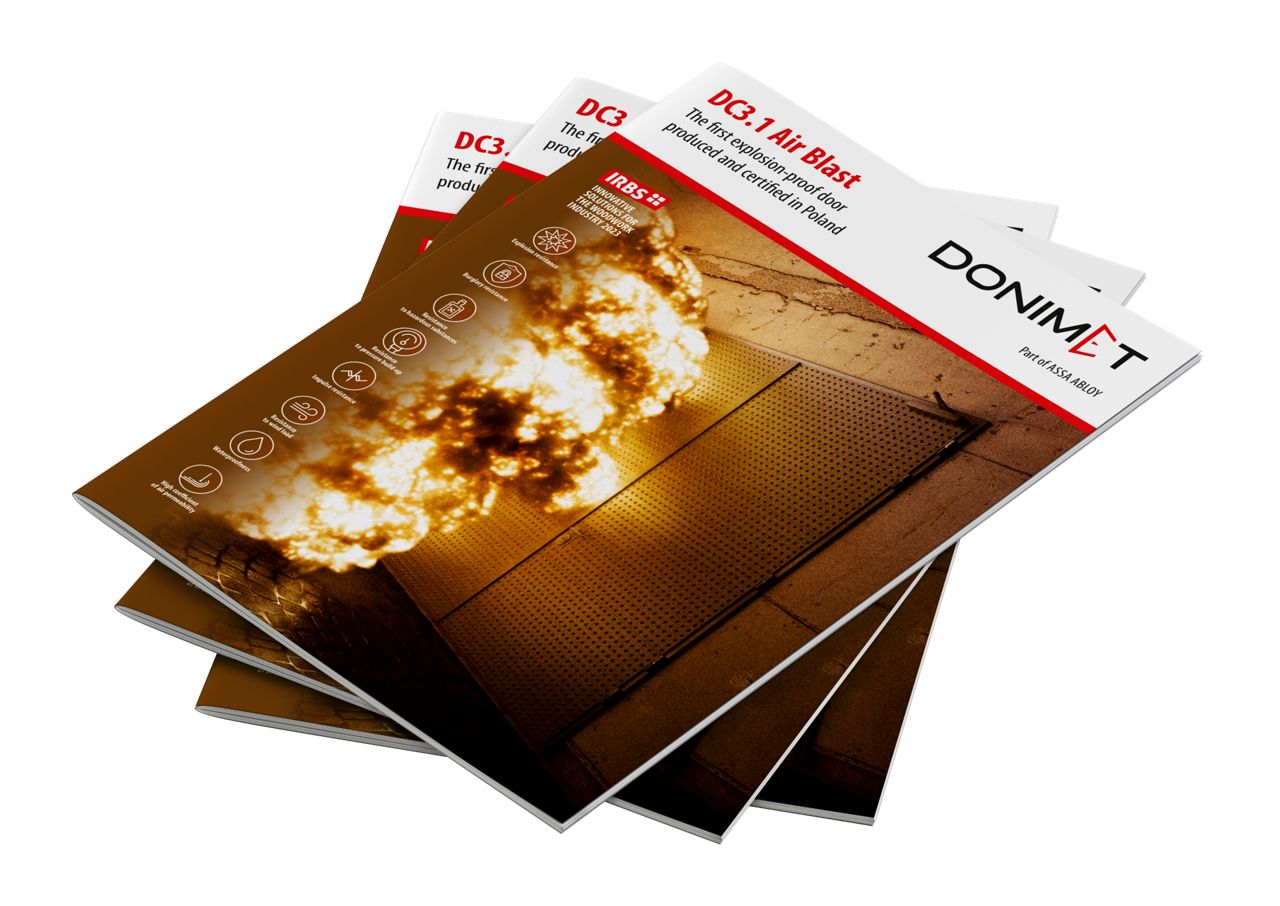
DC3.1 Air Blast Door
The first explosion-proof door produced and certified in Poland
Air Blast Door
Donimet explosion-proof doors DC3.1 AB were created in response to the current situation in the world, constantly growing threats. This is the first solution of this type produced from start to finish in Poland.
They are characterized by a very solid internal structure, and the EXR2 class doors are additionally covered with explosion-proof armour on the entire surface from the side exposed to explosion. Our team of experienced engineers has created a unique solution to disperse the shock wave and reduce its destructive impact on the door structure.
The materials used as well as the construction of the leaves and the frame prevent the door from being torn out or opened in the second phase of an explosion as a result of the huge negative pressure generated. The durability of the product has been confirmed by independent tests carried out by the Institute of Precision Mechanics, certification of explosion-proof doors according to the PN-EN 13123-2:2004 standard.

Learn more about the advantages of the DC3.1 AB explosion-proof door
Explosion resistance
class EXR1 for the model DC 3.1 AB I and class EXR2 for the model DC 3.1 AB II acc. to PN-EN 13123-2:2004
Burglary resistance
class RC4 acc. to PN-EN 1627:2012
Resistance to hazardous substances
PZH (Polish Hygiene Centre) Certificate acc. to PN-EN14351-1+A1:2010
Resistance to pressure build-up
Pso 0.75bar / 75kPa for the model DC 3.1 AB I and Pso 2.30 bar / 230kPa for the model DC 3.1 AB II
Impulse resistance
1.05 bar/ms / 105 kPa/ms for the model DC 3.1 AB I and 1.65 bar/ms / 165k Pa/ms for the model DC 3.1 AB II
Resistance to wind load
class 5C acc. to PN-EN 12210:2001
Waterproofness
class 3A acc. to PN-EN 12208:2001
Air permeability
class 4 acc. to PN-EN12207:2001


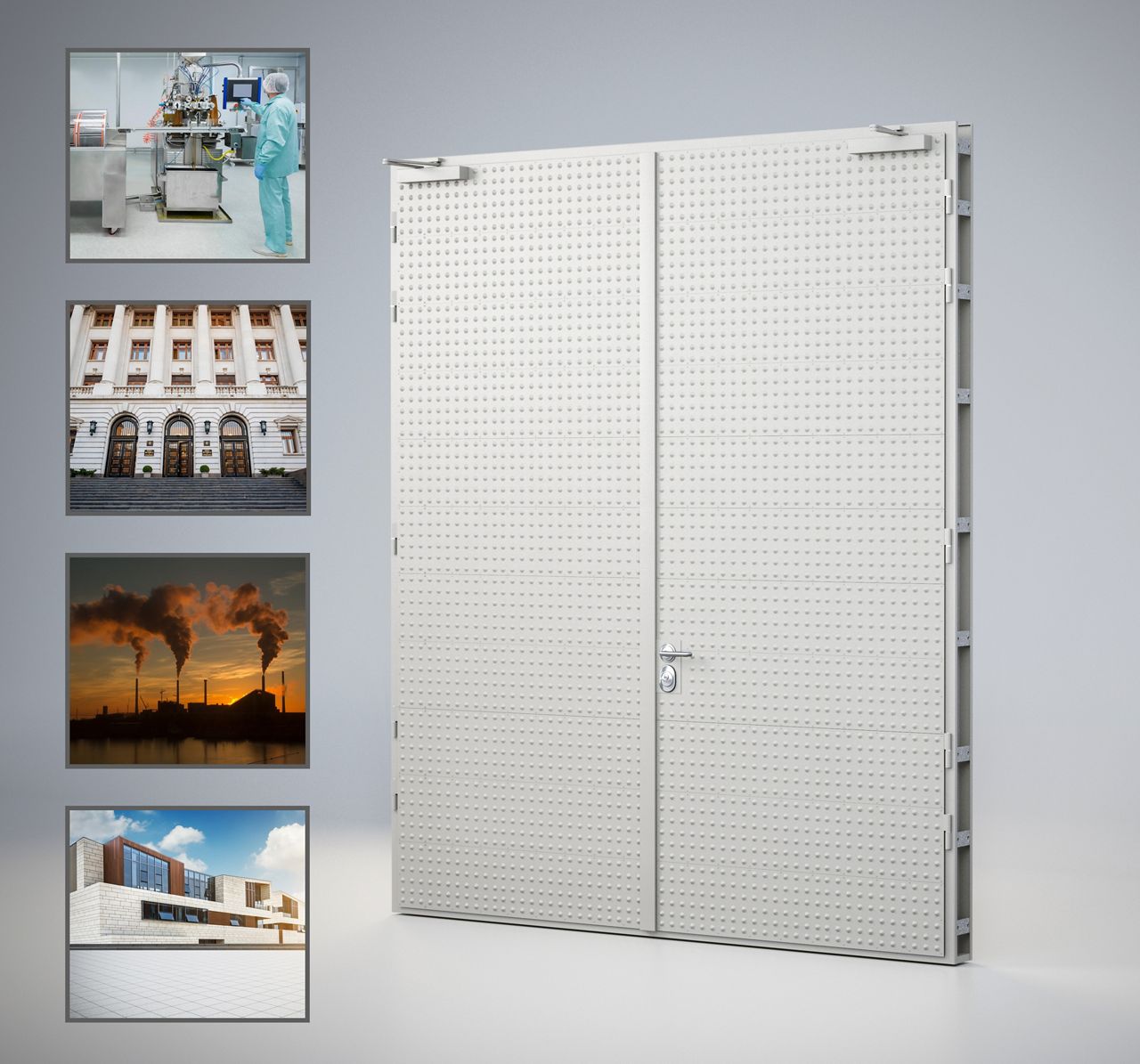
Air Blast door - where they will be applied?
- military, government, diplomatic, police and all other facilities exposed to the risk of being attacked with explosives,
- laboratories in which research posing a risk of explosion is conducted,
- industrial facilities, in particular petrochemical and energy - nuclear power and other facilities where there is a risk of explosion,
- explosion hazard zones with the risk of an explosive atmosphere (gases, dusts).

Contact the expert
We will answer any questions about our offer and help you adapt our solutions to your project. Send the form and we will contact you within 48 hours to answer your inquiry.