The right access control solution reduces energy use and can improve building sustainability performance

Even a glance at business journals shows that sustainability is a key strategic priority for many organizations. But where to begin in addressing this complex, multifaceted issue?
For many businesses, examining the buildings they inhabit — and the energy consumed there — could be a rewarding start.
Buildings consume around 30% of the world’s energy. Reducing unnecessary energy use can make an impact almost immediately, on both emissions and the business’ bottom line.
Energy use by access control systems
One often overlooked contributor to a building’s energy consumption is the electronic access control system. It can be surprisingly resource hungry.
Innovative new digital solutions take a different approach.
Electronic devices for doors and other openings, powered without mains electricity or batteries, contribute to improved sustainability performance, while reducing energy and maintenance costs.
Traditional wired locks operate with an ‘always on’ supply of mains electricity. This powers the magnets and readers which keep doors secure.
Installation of wired systems, too, can be intensive and intrusive — another high-energy process. Wireless, battery-free devices are much faster to fit.
Energy harvesting door locks, instead of mains power or batteries
The potential to ‘harvest’ energy from the world around us has been studied since at least the 1980s. A recent boom in the deployment of smart and Internet of Things (IoT) devices has accelerated interest and innovation.
In a self-powered access control system, the kinetic energy from inserting and/or turning a programmable key is harvested to power a lock’s digital security. This energy source — the keyholder — is sufficient and renewable.
No mains electricity or batteries means zero energy consumption at the door.
In addition, these self-powered locking cylinders are easier and faster to install than comparable wired access technologies, because they require no major adjustments around a door.
An installer simply swaps out its existing mechanical cylinder.
No cabling or mains connection typically reduces the need for regular maintenance, which may be expensive if electrical contractors must visit the site.
ASSA ABLOY PULSE: digitalize access control with confidence
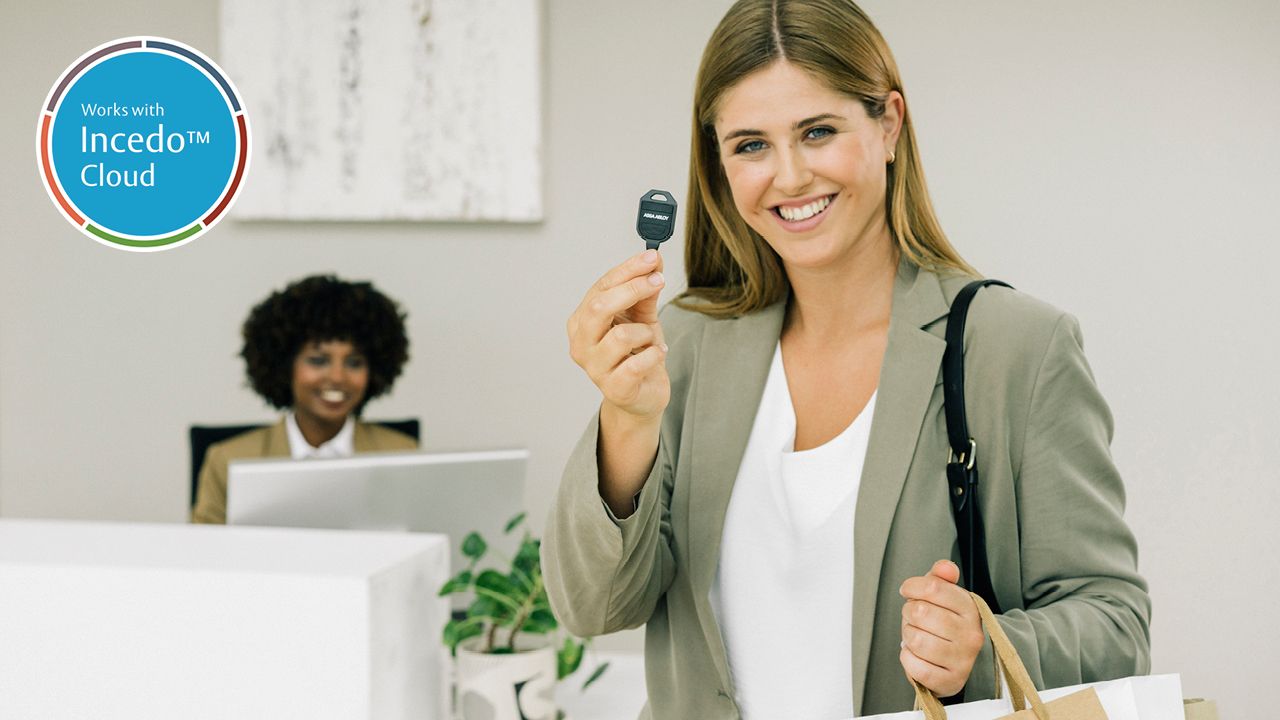
ASSA ABLOY PULSE cylinders and padlocks are powered entirely by energy harvesting. They offer intelligent programmable key-based digital access control without cables or batteries.
PULSE’s sustainability credentials were confirmed by winning the 2022 Danish Building Centres Energy Award, whose purpose is to “celebrate innovative products and solutions in construction and to increase knowledge of climate-friendly building materials.”
ASSA ABLOY PULSE devices need no external energy source. The cylinder’s encrypted electronic security is energized with power generated by key insertion.
Premises can equip almost any opening from a PULSE range which includes door cylinders, cam-locks, furniture locks and padlocks which operate reliably outdoors even in the harshest weather.
Convenient, efficient, scalable and futureproof
PULSE is also convenient for users: They carry one key pre-programmed with all their cleared access rights, no matter how many devices they must unlock.
PULSE keys and cylinders are reusable and reprogrammable: Managing staff, contractor or tenant turnover becomes faster and simpler.
To maximize the efficiency of access management, PULSE is part of the Incedo access control ecosystem: a completely flexible, scalable platform, where locks for every application may be managed together from a single interface.
PULSE’s full integration with Incedo software means self-powered devices may be combined with a broad range of trusted ASSA ABLOY battery powered and wired digital locks, where these are required to supplement PULSE for specific applications or openings.